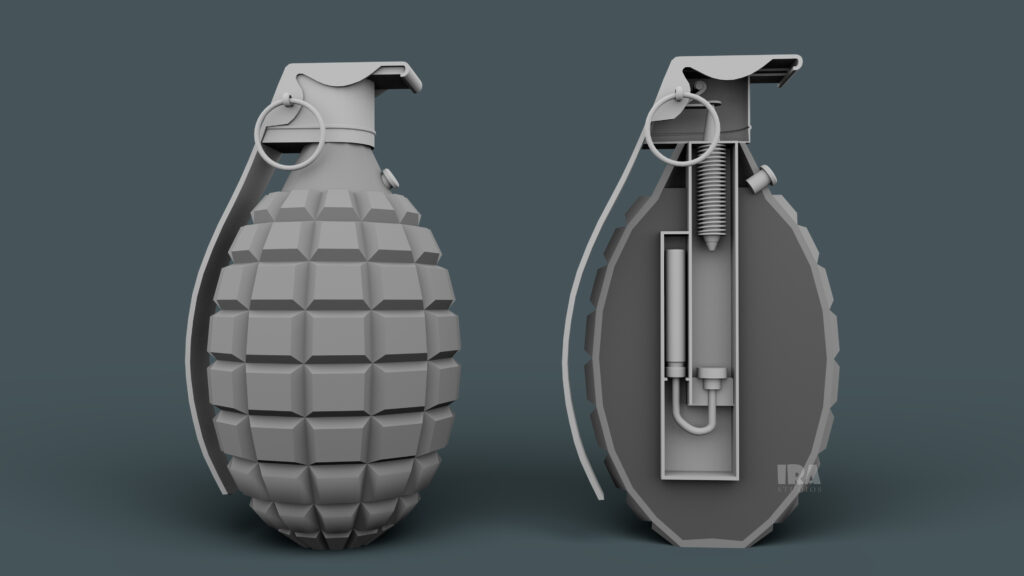
How does a grenade work? 3D Explanation
In this 3D explanation, we explore how a grenade functions using detailed 3D visuals and simplified internal views.
Grenades have played an important role in military history, particularly during the World Wars, and they continue to exist within modern defense systems. Over time, different types of grenades have been developed, each designed for specific tactical and strategic purposes such as area control, signaling, and controlled energy release.
Among these designs, time‑delay fragmentation grenades are one of the most widely recognized. In this blog, we focus on explaining their internal structure and working principles through clear 3D animation, with an emphasis on engineering design, safety mechanisms, and historical context rather than combat use.
Structure of a Grenade
How does a Grenade work? 3D Explanation -Parts (See IMAGE-1)
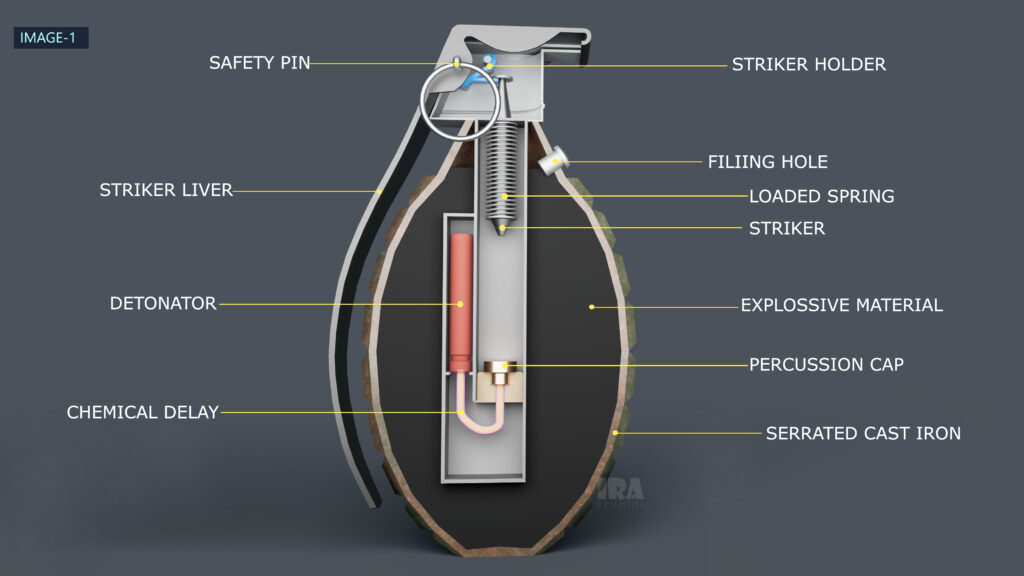
The outer shell of a fragmentation grenade is made of serrated cast iron. These serrations help it to break into deadly fragments upon explosion.
The inside of the grenade is filled with explosive material—commonly a mixture of TNT and RDX.
There is a filling hole through which the explosives are inserted into the grenade.A typical fragmentation grenade consists of a strong outer shell, usually made from serrated cast iron. The serrated design helps the shell break apart in a controlled manner when the internal charge is activated, allowing the energy of the explosion to spread outward efficiently.
Inside the shell, the grenade contains an explosive filling, commonly a combination of high‑energy materials such as TNT and RDX. These materials are chosen for their stability during handling and their ability to release energy rapidly when triggered.
A small filling hole is built into the grenade’s body during manufacturing. This opening is used to insert the explosive material and is later sealed securely, ensuring the internal components remain protected and stable until activation.
Safety Mechanism
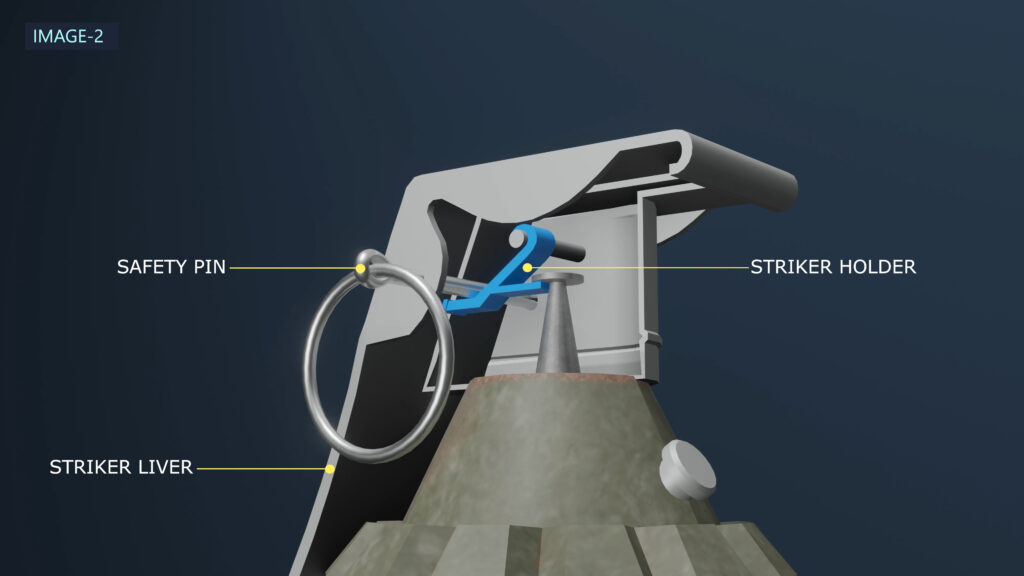
The safety pin (see Image 2) is designed to keep the striker lever, often called the “spoon,” firmly in place. Its main function is to prevent the internal mechanism from activating accidentally during handling or transport.
As long as the striker lever is held down, the grenade remains inactive. Even if the safety pin is removed, the device will not activate while the lever is still pressed against the body.
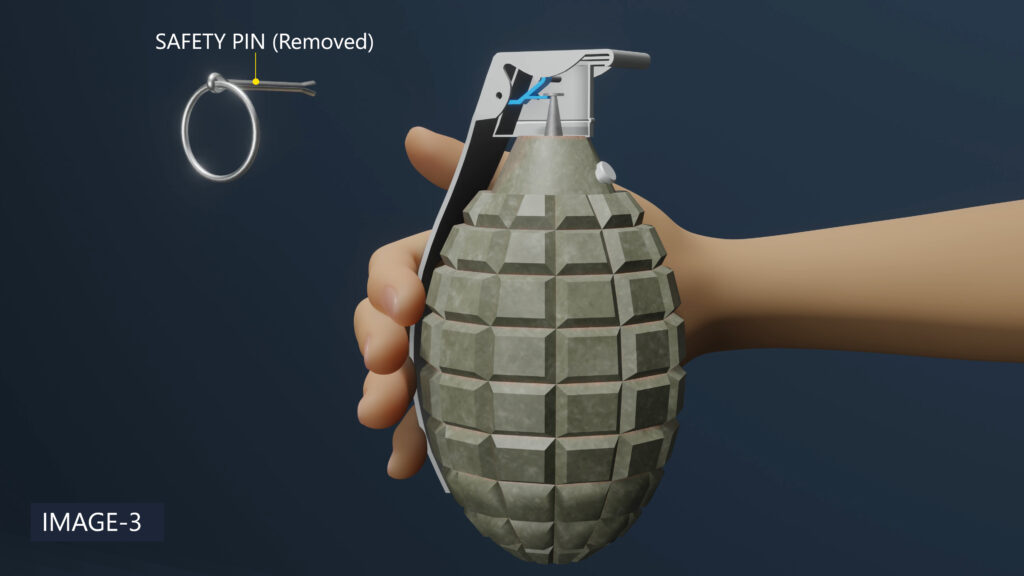
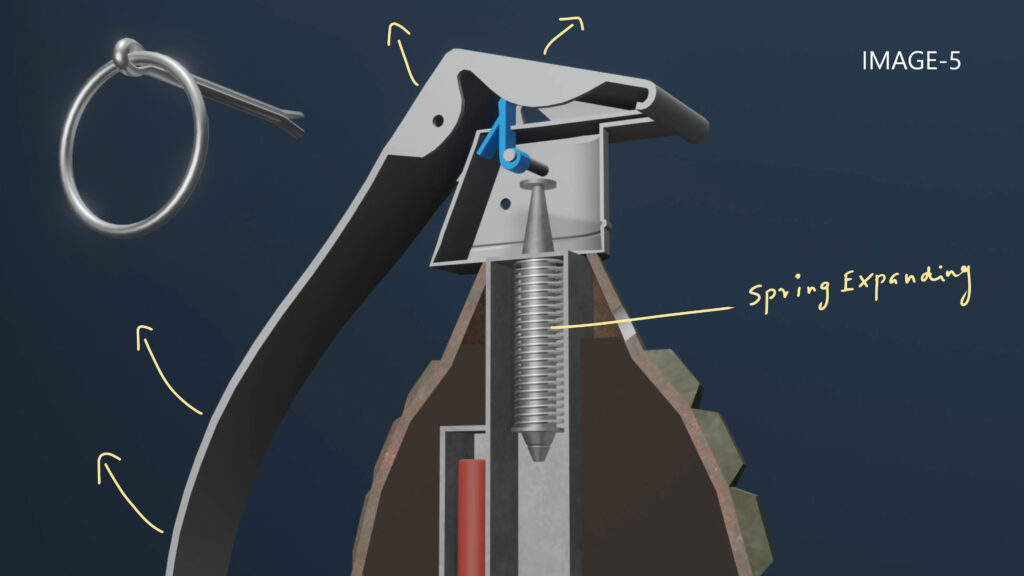
Once the safety pin is pulled and the striker lever is released, the lever moves outward due to spring tension, allowing the internal mechanism to engage (see Image 3). This design provides a controlled sequence of actions, ensuring the grenade only activates when both safety conditions are removed.
How Does a Grenade Work? Internal Mechanism
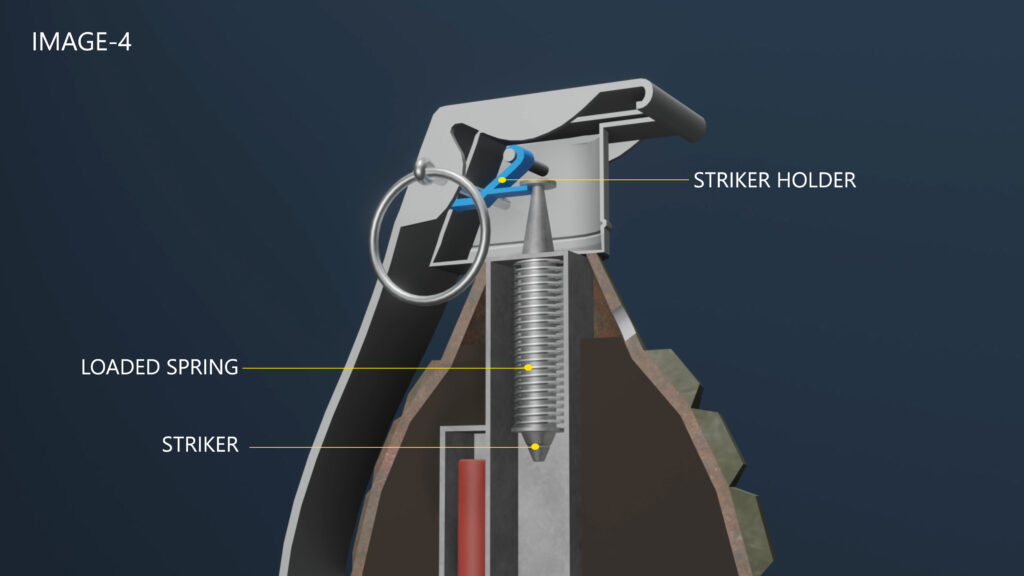
To better understand how a grenade functions, let’s look at its internal components using a simplified 3D view. Inside the casing, there is a spring, a striker, and a striker holder, all arranged to work in a precise and controlled sequence (see Image 4).
When the external safety components are disengaged, the striker lever moves outward (see Image 5). This allows the compressed spring inside the grenade to expand, pushing the striker forward (see Image 6).
The striker then makes contact with a percussion cap, which contains a small amount of impact‑sensitive material. This contact produces a spark that activates a built‑in delay element.
The delay element burns for a short, predetermined duration—typically a few seconds—before triggering the next stage of the mechanism. This timed sequence is intentionally designed to control when the main reaction occurs, highlighting the importance of precision and safety in the grenade’s internal engineering.
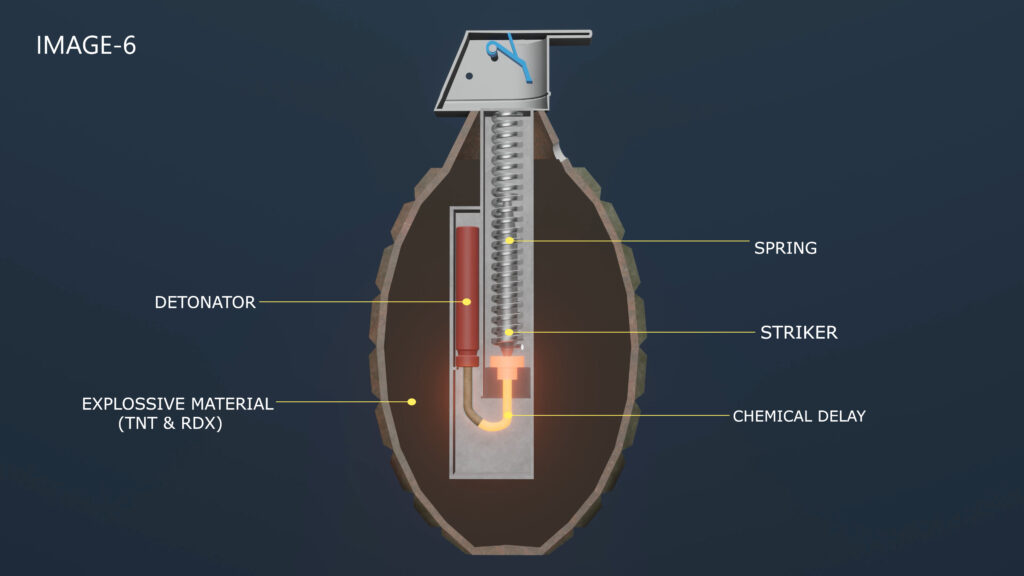
At the end of the delay fuse is a detonator, a small capsule containing a highly sensitive initiating material. When the burning fuse reaches this component, it triggers a controlled chain reaction that activates the grenade’s main charge.
This rapid release of energy causes the outer shell to break apart along its pre‑designed structure. The casing fragments are propelled outward by the expanding gases, spreading force over the surrounding area. This mechanism is why fragmentation grenades are effective within a limited radius and why their design emphasizes controlled timing and predictable energy distribution.
Real‑Life Use of Grenades in Modern Context
Grenades continue to be relevant in modern military and security environments, even as warfare becomes increasingly driven by advanced technology. Despite the presence of drones, precision‑guided weapons, and sophisticated surveillance systems, grenades remain compact devices designed for situations where larger systems may be impractical or ineffective.
In densely built environments, such as urban areas, confined spaces can limit visibility and movement. In these situations, compact tools like grenades are sometimes used as part of coordinated operations to disrupt hostile positions and allow safer movement for personnel. Similarly, in challenging terrains such as jungles or mountainous regions, where visibility is low and access is limited, such devices may be employed to address concealed or fortified locations.
Modern grenade designs have evolved significantly from earlier versions. Contemporary models often incorporate enhanced safety features, controlled energy output, and specialized functions. Some are designed for controlled explosive effects, while others serve non‑lethal or tactical roles, such as producing smoke for concealment, emitting intense light and sound for temporary disorientation, or marking locations during coordinated missions. This adaptability allows them to be used in a wide range of regulated scenarios.
Beyond military applications, certain grenade‑based devices are also used by law enforcement and special response teams. For example, non‑lethal distraction devices are employed during high‑risk operations to momentarily disorient individuals, helping reduce potential harm to both officers and civilians. Their use is governed by strict protocols and legal oversight to ensure responsible deployment.
From an educational and engineering perspective, grenades are often studied as examples of compact mechanical design and controlled energy release. Examining their structure and timing systems provides insight into materials science, safety engineering, and precision manufacturing. Their continued presence highlights how relatively small devices can have significant operational importance when carefully designed and responsibly used.
Overall, grenades demonstrate the balance between simplicity and technological refinement. While the basic concept has existed for centuries, modern designs reflect ongoing innovation, regulation, and adaptation to contemporary needs, making them an enduring subject of study in military history, engineering, and applied science.
Civilian and Training Applications
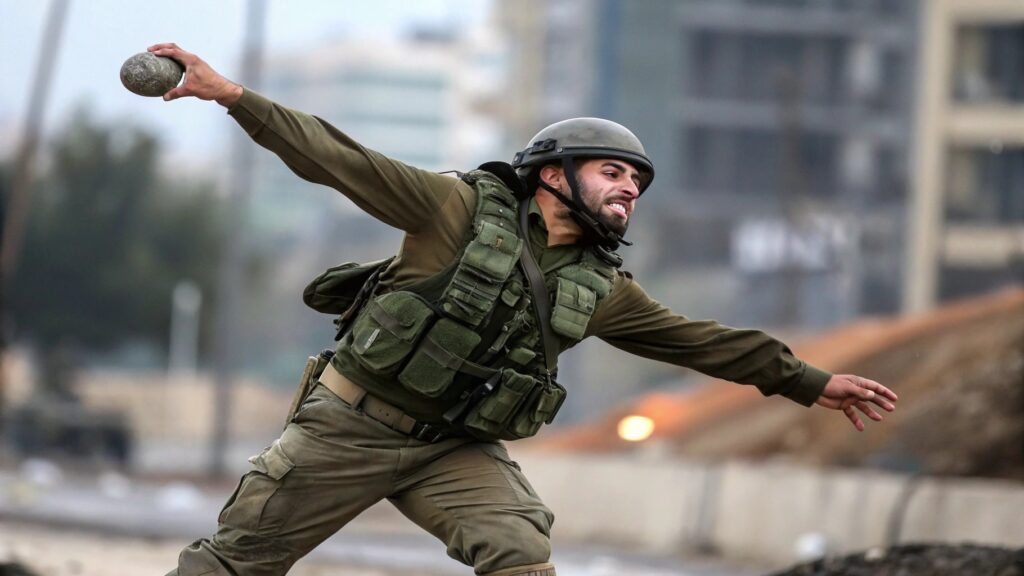
While grenades are primarily associated with warfare, their use in training and controlled environments is just as important. Military forces around the world rely on practice or dummy grenades to train soldiers safely before they ever encounter live combat situations. These training versions are carefully designed to replicate the weight, size, balance, and basic mechanical feel of real grenades, but without any explosive charge.
The purpose of these dummy grenades is education and muscle-memory development. Soldiers learn proper handling, grip, coordination, and situational awareness in a risk-free setting. Repeated training with inert grenades helps build confidence, discipline, and consistency, ensuring that real-world mistakes are minimized. This kind of preparation is critical, as even small errors in handling battlefield equipment can have serious consequences.
Some training grenades also include sound or visual indicators, such as small pop charges or smoke, to simulate the stress and timing of real scenarios without causing harm. These simulations help soldiers adapt to pressure, noise, and urgency, making training more realistic while maintaining strict safety standards.
Beyond the military, similar training devices are used by law enforcement and special response units. Tactical teams practice coordinated movements, room clearing, and controlled entry techniques using non-lethal or inert grenade simulations. This allows teams to refine communication and teamwork while protecting both personnel and civilians.
In educational and museum settings, inert grenades are sometimes displayed to demonstrate historical development and engineering principles. They serve as learning tools rather than weapons, helping people understand how design, safety mechanisms, and materials evolved over time.
Overall, civilian and training applications highlight an important reality: not all military equipment is used for destruction. In many cases, these tools exist to teach discipline, promote safety, and prevent accidents. Practice grenades play a vital role in preparing personnel responsibly, reinforcing the idea that knowledge, training, and control are just as important as the technology itself.
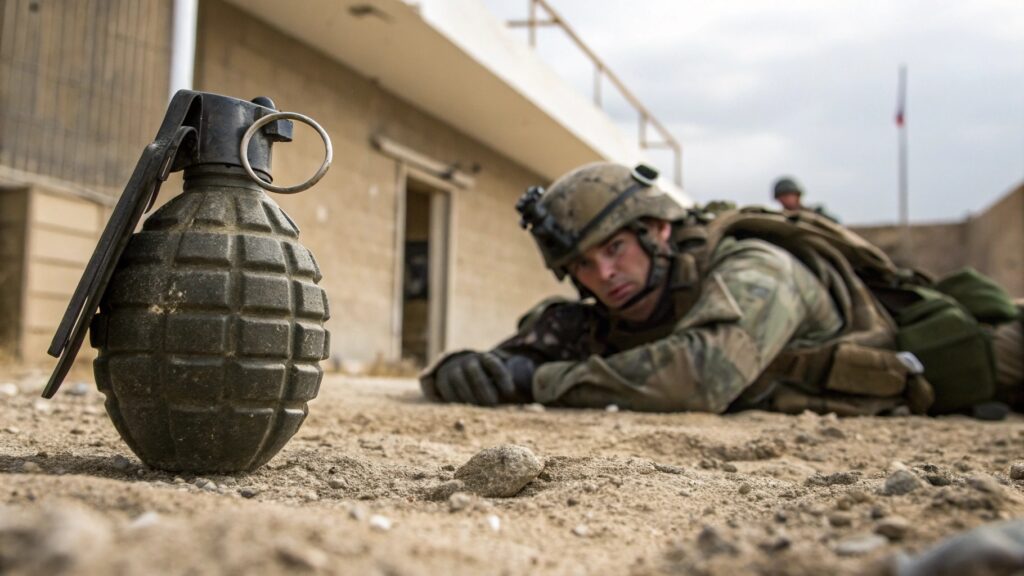
A Major Drawback
Although time‑delay grenades are considered effective, they do have an important limitation. Because the delay before detonation is short, there is sometimes a brief window in which an opposing person may react after the grenade is deployed.
In certain situations, this reaction time can allow the device to be moved away or returned toward its source. This inherent risk highlights why timing, distance, and proper training are critical factors in the use of such devices, and why strict operational procedures exist to reduce unintended consequences.
About the Author
This article was prepared by the IRA Studios editorial team, creators of high-quality 3D educational visualizations designed to simplify complex ideas through clear and engaging visuals.
Watch the Full 3D Animation
To explore all of these processes in 3D, check out our detailed 3D Animation video.
Watch it in Malayalam
Want to learn more? Check out our detailed 3D explanation on How Does a Bullet Work?