What Is a Treadwheel Crane?
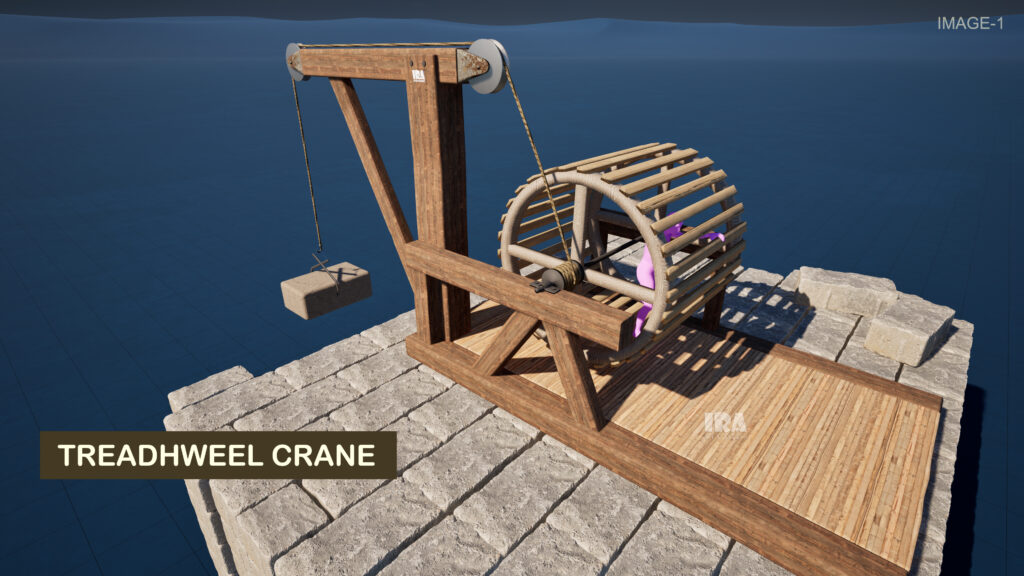
A treadwheel crane, also known as a human-powered crane, was a large wooden lifting device used during the Middle Ages and Roman period for lifting heavy construction materials. It relied solely on human power, where workers walked inside a large wheel — much like a hamster wheel — to generate lifting force.
These cranes were mainly used in the construction of cathedrals, castles, harbors, and other monumental structures, showcasing the brilliance of ancient mechanical engineering.
How Does a Treadwheel Crane Work?
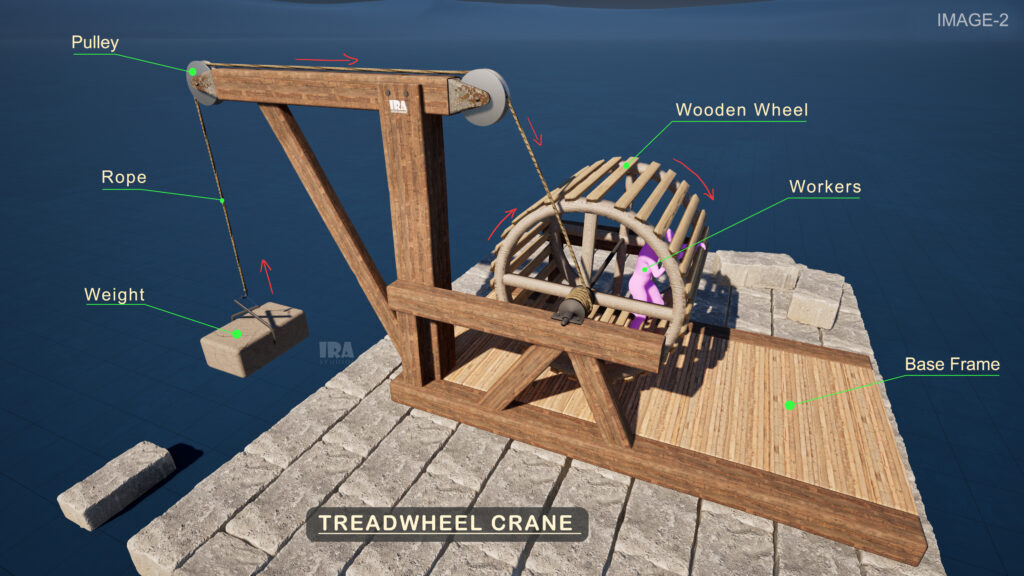
The working mechanism of a treadwheel crane is simple but effective:
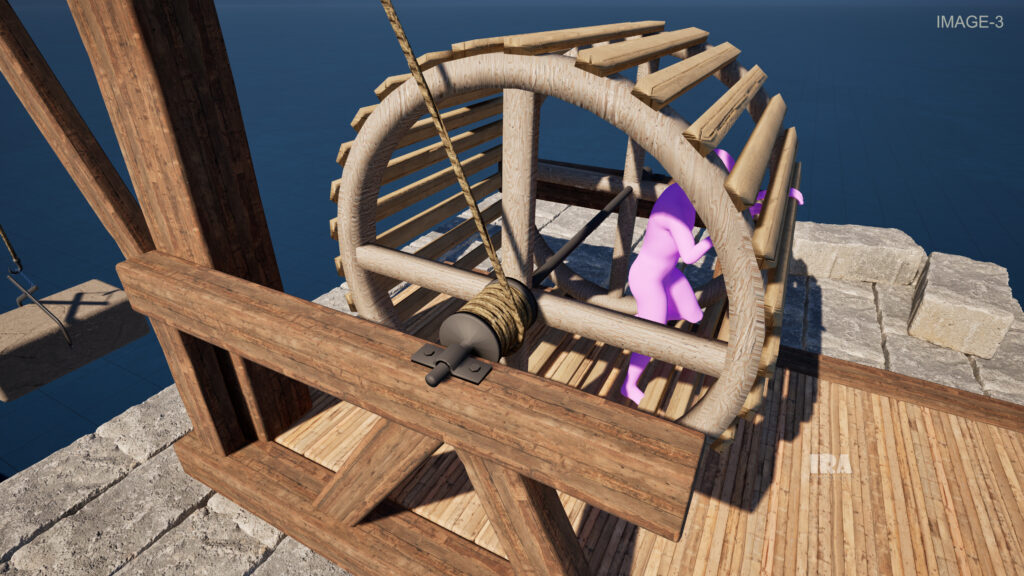
Treadwheel: A large circular wheel that a worker walks inside. This wheel acts as a winch drum.
Axle and Rope System: As the wheel turns, it rotates an axle connected to a rope or chain.
Hook or Pulley: Attached to the rope, this raises the load vertically as the wheel turns.
Base Frame: The wooden structure that holds everything in place and keeps it stable.
This system provides mechanical advantage, allowing a single human to lift heavy stones and logs many times their weight.
Materials and Design
Treadwheel cranes were primarily made of:
Oak or strong timber for the structural frame
Ropes made of hemp
Iron hooks and fastenings for durability
The design could be vertical (with the wheel on top) or horizontal depending on the lifting height and space constraints.
Where Were Treadwheel Cranes Used?
Treadwheel cranes were remarkable machines for their time, enabling people to lift and move heavy loads that would have been impossible with human strength alone. They found wide application across several periods and regions, serving as essential tools in construction, trade, and transportation.
During the Roman Empire, treadwheel cranes were commonly used in harbors, quays, and aqueduct projects. Large stones, columns, and other construction materials were lifted and positioned with precision, allowing engineers to build massive public works, including bridges, amphitheaters, and monumental buildings. The efficiency of these cranes helped the Romans achieve feats of engineering that still inspire admiration today.
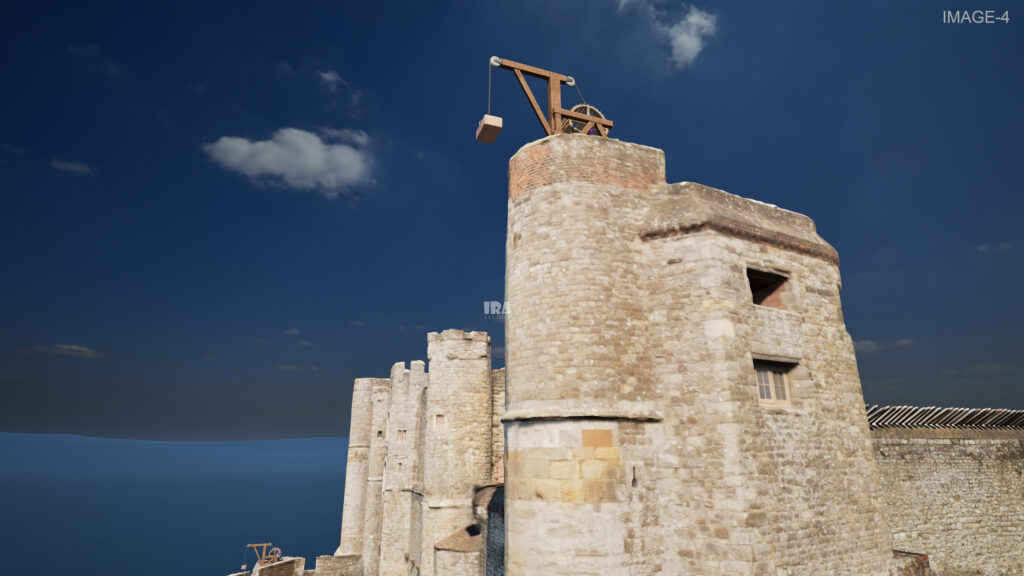
In the Middle Ages, treadwheel cranes became central to the construction of cathedrals, castles, and city walls. Builders used them to lift heavy stones, timber beams, and metal components to great heights. Some cranes were mounted on castle towers or scaffolds, giving workers the ability to transport materials vertically without endangering themselves. Others were set up on mobile platforms or wheels, allowing them to be moved around the construction site as needed. These cranes dramatically increased the speed and scale of medieval building projects.
Treadwheel cranes were also widely used in shipyards, where loading and unloading heavy cargo, barrels, and building materials posed significant challenges. With the help of these machines, dockworkers could efficiently manage the movement of goods, fueling trade and commerce across rivers, seas, and ports.
The versatility of treadwheel cranes was one of their greatest strengths. They could be adapted to different environments, whether fixed atop towers, integrated into scaffolding, or mounted on wheels for mobility. This adaptability made them indispensable in both urban and rural construction projects, from monumental public works to private buildings and fortifications.
In essence, treadwheel cranes were more than just lifting devices. They were catalysts for architectural and engineering progress, enabling civilizations to build taller, stronger, and more ambitious structures than ever before. Their widespread use across different eras underscores their importance as one of the key innovations that shaped human construction and trade for centuries.
Why Is It an Engineering Marvel?
The treadwheel crane is considered an engineering marvel because it transformed human effort into enormous lifting power with elegance and efficiency. By harnessing human kinetic energy, it allowed a few workers to lift loads that would have otherwise required dozens of people. Unlike many other lifting methods of its time, it required no fuel or animals, making it economical, sustainable, and practical for long-term construction projects.
The crane provided an impressive mechanical advantage, often reaching ratios of 5:1 or higher. This meant that the force applied by workers walking inside the large wheel was amplified multiple times, allowing enormous stones, timber, or cargo to be lifted with relative ease. By combining principles of simple machines such as the wheel and axle, pulleys, and levers, the treadwheel crane showcased a deep understanding of physics long before these concepts were formally studied.
Durability and adaptability were other hallmarks of the design. Treadwheel cranes were built to last, often from robust timber reinforced with iron fittings, and could be reused across multiple construction projects. Some were mounted permanently on towers, while others were mobile, allowing builders to move them as needed on large sites. Their adaptability made them invaluable for a wide range of tasks, from raising stones for castles and cathedrals to loading heavy goods in harbors and shipyards.
Even today, the treadwheel crane is studied in engineering schools and by historians as a prime example of mechanical ingenuity. It demonstrates how early engineers maximized efficiency with minimal resources, combining human effort, simple tools, and clever design to achieve extraordinary results. The principles behind the treadwheel crane — leveraging mechanical advantage, balancing loads, and converting linear and rotational motion — remain relevant in modern engineering and continue to inspire students and professionals alike.
In short, the treadwheel crane is more than just a historical artifact. It represents the timeless brilliance of human problem-solving, the power of applying fundamental physics to real-world challenges, and the enduring value of simple yet ingenious machines. Its legacy is a reminder that innovation does not always require complexity; sometimes, the simplest solutions can leave the biggest impact.

Conclusion
The treadwheel crane is a powerful symbol of how ancient civilizations mastered physics and engineering long before the invention of engines. Its simple yet smart mechanism reminds us that innovation doesn’t always need electricity — just ingenuity.
About the Author
This article was prepared by the IRA Studios editorial team, creators of high-quality 3D educational visualizations designed to simplify complex ideas through clear and engaging visuals.
Watch the Full 3D Animation
To explore all of these processes in 3D, check out our detailed 3D Animation video.
Watch it in Malayalam
Want to learn more through visual storytelling? Check out our detailed 3D explanation blog on The Dark History of the Treadmill: From Torture Device to Fitness Machine
References and Useful Links