
How Does a Water Tap Work? Explained with 3D
Water taps, also called faucets, are one of the most commonly used devices in every home. Whether in kitchens, bathrooms, or gardens, we use taps every day to control the flow of water. But have you ever wondered what happens inside a tap when you turn the handle?
In this article, we will explore how a water tap works using simple explanations. You’ll learn about its internal parts, the working mechanism, and the different types of taps commonly used in homes. With clear illustrations and 3D cross-sectional visuals, it becomes easy to understand how each component works together to control the flow of water.
Main Components of a Water Tap

Handle
Threaded spindle
Jumper
Rubber washer
Valve seat
Tap body
Water inlet and outlet
Working Principle of a Compression Valve Tap
Every tap is connected to a water supply pipeline. When the tap is closed, water enters the tap body but cannot flow out. This is because the rubber washer presses tightly against the valve seat, creating a seal.
This seal prevents water from passing through the outlet.
Think of it like a door that is firmly closed — water is waiting behind it but cannot escape.
1. Tap in Closed Position

When the tap is closed (See above image):
The handle is tightened.
The threaded spindle moves downward.
The jumper and rubber washer also move downward.
The rubber washer presses tightly against the valve seat.
This creates a watertight seal.
Water flow stops completely.
The rubber washer is the key component that blocks the water.
2. Tap Opening Process

When you rotate the handle to open the tap (See above image):
The threaded spindle moves upward.
The jumper and washer move upward along with it.
This creates space between the washer and valve seat.
Water now has a path to flow through the tap outlet.
As the opening increases, more water flows out.
3. Tap Closing Process
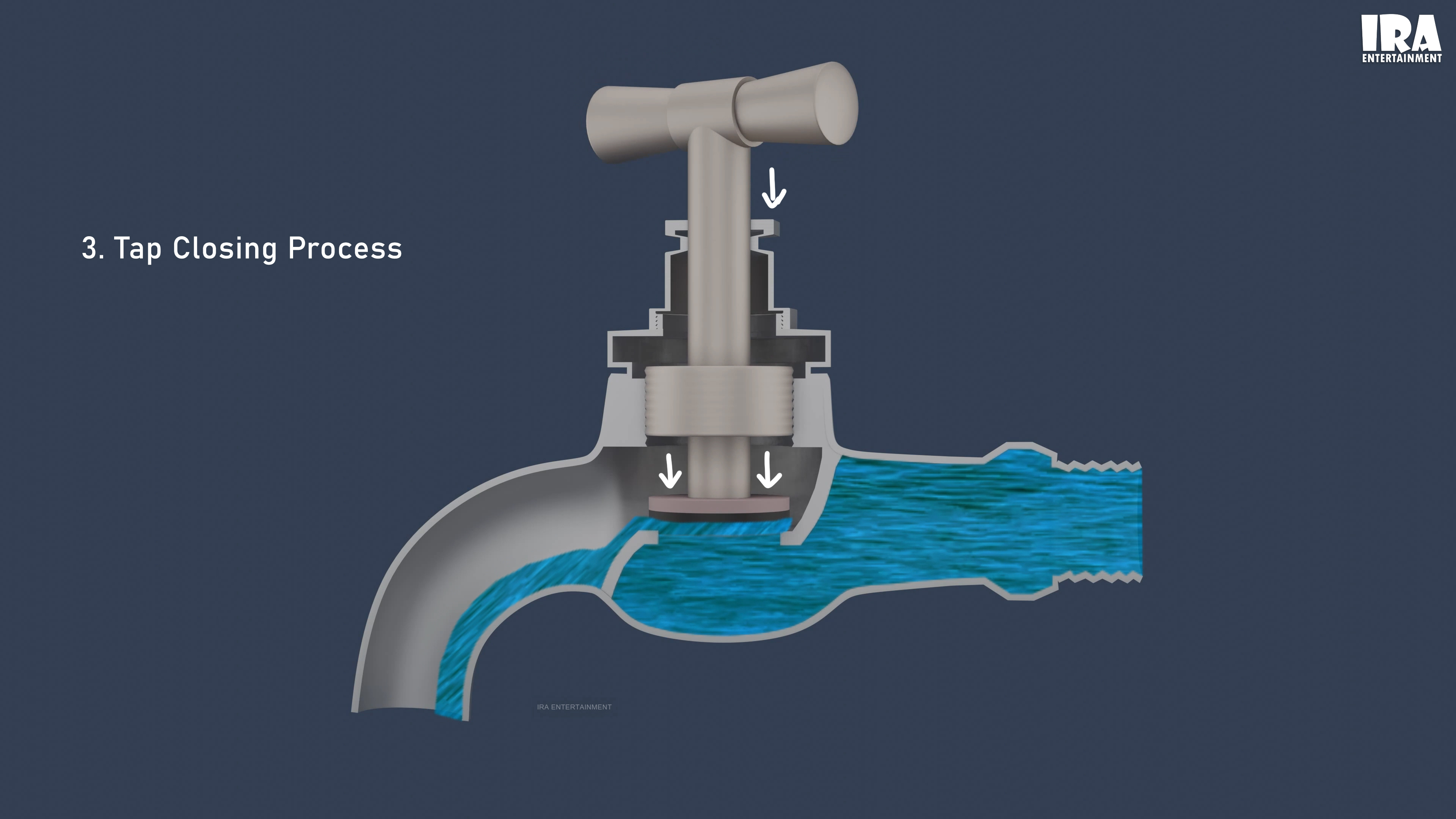
When you rotate the handle in the opposite direction:
The spindle moves downward again.
The washer presses back onto the valve seat.
The water passage closes.
The flow stops completely.
This simple up-and-down movement controls the entire water flow.
Why Rubber Washer Is Important

The rubber washer plays a critical role in sealing the tap. It is designed to:
Prevent leaks
Provide a tight seal
Handle water pressure
Over time, washers can wear out. When this happens, taps may start dripping. Replacing the washer usually fixes the problem.
Compression Valve Tap in Kitchen Faucets

Kitchen taps often use the same compression valve mechanism. The only difference is the external design and shape (See above image).
Inside, the same components are present:
Threaded spindle
Jumper
Washer
Valve seat
The working principle remains exactly the same — lifting the washer allows water to flow, and pressing it down stops the flow.
Ball Valve Tap

Another very common type of tap is the ball valve tap. These are often used in gardens, outdoor areas, and modern plumbing systems.
Instead of a washer and spindle, this tap uses a rotating ball with a hole through its center.
Main Parts of Ball Valve Tap

Handle
Ball assembly
Inlet and outlet pipe
Valve body
The ball inside the tap controls water flow.
How Ball Valve Tap Opens

When you turn the handle (See above image):
The ball rotates.
The hole inside the ball aligns with the pipeline.
This creates a clear path for water.
Water flows freely through the tap.
How Ball Valve Tap Closes

When you turn the handle again:
The ball rotates 90 degrees.
The hole becomes perpendicular to the pipeline.
The water path is blocked.
Water flow stops completely.
Why Ball Valve Taps Are Popular
Ball valve taps offer several advantages:
Faster operation
Better durability
Less leakage risk
Easy to use
Longer lifespan
They are commonly used in modern plumbing systems.
Conclusion
Water taps may look simple from outside, but inside they use clever mechanical systems to control water flow. Compression valve taps use a threaded spindle and rubber washer to open and close water flow. Ball valve taps use a rotating ball with a hole to quickly allow or block water.
Both designs are effective, reliable, and widely used in homes around the world.
With the help of 3D cross-sectional images, it becomes much easier to visualize how each component moves and works together.
Watch the Full 3D Animation
To explore all of these processes in 3D, check out our detailed 3D Animation video.
Want to learn more through visual storytelling? Check out our detailed 3D explanation blog on How Does a Hand Pump Work? Simple 3D Explanation