Point Nemo: The Most Remote Place on Earth!
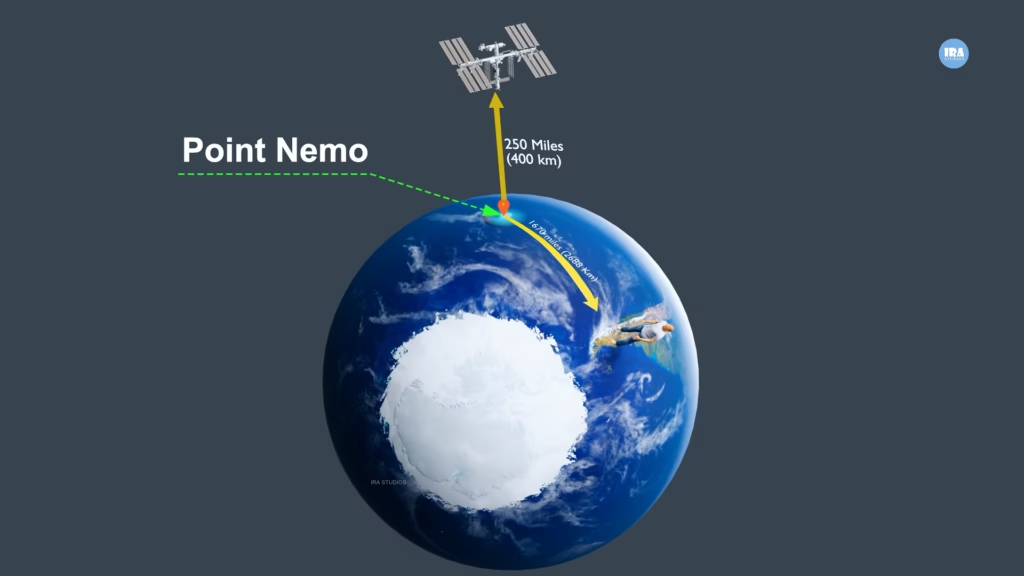
There is a place on Earth where, at certain times, the closest humans may be astronauts aboard the International Space Station (ISS) passing overhead. This remote location is known as Point Nemo, the most isolated point in the ocean.
Located in the South Pacific Ocean, Point Nemo is the oceanic pole of inaccessibility — the point in the ocean farthest from any land. It lies approximately 2,688 kilometres (1,670 miles) from the nearest land in every direction.
Imagine being surrounded by thousands of kilometres of open ocean, with no islands or coastlines nearby. That is what makes Point Nemo one of the most remote places on our planet.
Watch the full animated visual presentation of this topic at the end of this blog.
Where Is Point Nemo Located?
Point Nemo is situated in the South Pacific Ocean, at approximately 48°52.6′ south latitude and 123°23.6′ west longitude.
It is about 2,688 km (1,670 miles) from each of its three nearest land areas: Ducie Island, part of the Pitcairn Islands; Motu Nui, a small islet near Easter Island; and Maher Island, near Antarctica.
Point Nemo is not an island or a piece of land. It is a geographical point in the open ocean, named after Captain Nemo, the fictional character from Jules Verne’s novel Twenty Thousand Leagues Under the Seas.
Why Can Astronauts Be Closer Than Other Humans?
One of the most fascinating facts about Point Nemo is that astronauts aboard the International Space Station can sometimes be closer to it than people on land.
The ISS orbits Earth at an altitude of approximately 400 km (250 miles). Since Point Nemo is about 2,688 km (1,670 miles) from the nearest land, the station can pass much closer to the point than any person standing on a nearby island or continent.
However, this does not happen all the time. It depends on the ISS’s position in its orbit. When the station passes almost directly overhead, its distance from Point Nemo can be only around 400 km (250 miles).
Why Is Point Nemo So Isolated?
Point Nemo lies in a vast region of the South Pacific far from major landmasses. The surrounding ocean has very low concentrations of nutrients compared with many coastal waters, making it one of the least biologically productive regions of the ocean.
This does not mean the area is completely lifeless. Marine organisms still live there, but relatively low nutrient availability limits the growth of microscopic marine plants, known as phytoplankton, which form the foundation of many ocean food webs.
The region is also far from major shipping routes and population centres, making it difficult and expensive to reach. There are no permanent human settlements at Point Nemo itself.
Point Nemo: The Spacecraft Graveyard
Point Nemo is also associated with one of the most unusual uses of the remote ocean: the controlled disposal of retired spacecraft.
When certain satellites, space stations and other spacecraft reach the end of their operational lives, their operators may guide them back into Earth’s atmosphere. If the spacecraft is too large for all its components to burn up during re-entry, operators can target a remote area of the South Pacific to reduce the risk to people and property.
This region is commonly called the spacecraft graveyard or the South Pacific Ocean Uninhabited Area. It has been used for the controlled re-entry of large spacecraft, including Russia’s Mir space station in 2001.
The International Space Station is also expected to be deorbited at the end of its operational life, with NASA planning a controlled re-entry targeted toward this remote ocean region, subject to the final mission plan.
Despite the nickname, spacecraft are not simply buried intact on the ocean floor. They are guided through atmospheric re-entry, during which many components burn up. Any surviving debris falls into the ocean, where it sinks or otherwise disperses.
Is Point Nemo the Most Lifeless Place on Earth?
Point Nemo is often described as one of the most lifeless places in the ocean, but that description is an exaggeration.
Its remote location and low nutrient levels make it a region of relatively low biological productivity. Nevertheless, microorganisms and other marine life exist there, as they do in many parts of the open ocean.
The combination of extreme isolation, nutrient-poor waters and vast distances from land makes Point Nemo unusual, but it is not an ocean without life.
Why Is Point Nemo Important?
Point Nemo is more than a geographical curiosity. It demonstrates how scientists can identify the most remote locations on Earth and how space agencies can use isolated ocean regions to manage the risks associated with large spacecraft re-entry.
Although it is thousands of kilometres from the nearest land, Point Nemo remains part of Earth’s interconnected ocean system. Its isolation makes it a remarkable place for understanding ocean geography, marine ecosystems and the safe disposal of retired spacecraft.
Point Nemo reminds us that even on a planet as thoroughly explored as Earth, there are places where human presence remains exceptionally rare.
Watch the Full 3D Animation
To explore all of these processes in 3D, check out our detailed 3D Animation video.
Watch it in Malayalam!
Want to learn more through visual storytelling? Check out our detailed 3D explanation blog on Why Do We Always See the Same Side of the Moon? Tidal Locking Explained with 3D visuals
Useful Link :