Why don’t we feel the Earth rotating!
Earth is constantly moving through space at incredible speeds. At the equator, its rotation carries us at about 1,040 miles per hour (1,674 km/h). Meanwhile, Earth orbits the Sun at approximately 66,600 miles per hour (107,000 km/h).
That’s faster than many people can imagine. Yet we can walk, run, sit, and even enjoy a quiet afternoon without feeling that motion.
So, why don’t we feel Earth moving?
There are three main reasons.
Watch the full animated visual presentation of this topic at the end of this blog.
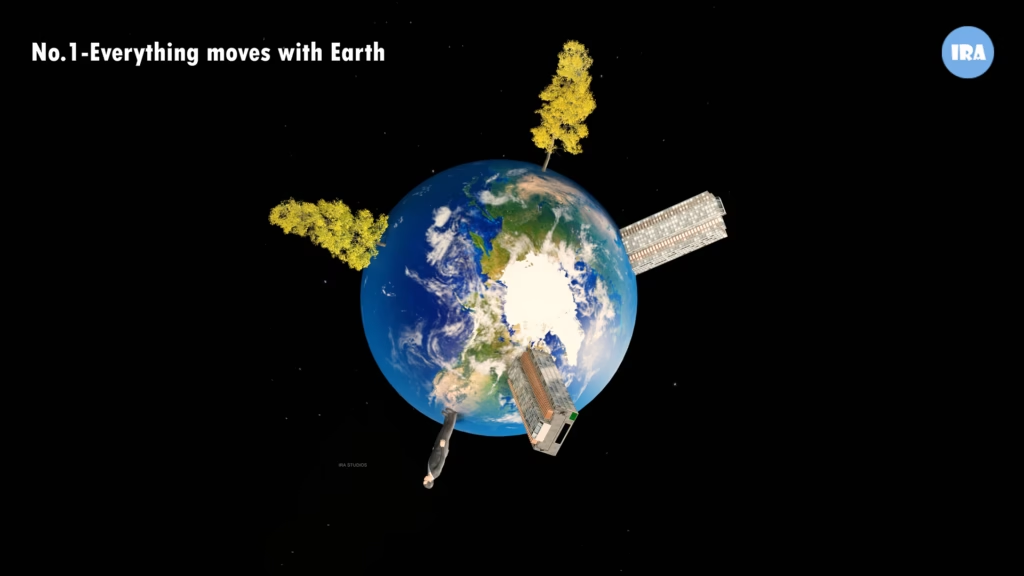
1. Everything Around Us Moves With Earth
Imagine you’re sitting inside a commercial airplane cruising smoothly at 550 mph (885 km/h). If the cabin is quiet and the plane isn’t accelerating or experiencing turbulence, you can comfortably read a book or drink water without feeling that you’re moving at such a high speed.
Why? Because you, your seat, the passengers, and the air inside the cabin are all moving along with the airplane.
The same basic principle applies to Earth.
The ground beneath our feet, buildings, oceans, and atmosphere all move along with our planet. We share Earth’s motion, so we don’t feel its speed simply because we’re moving with it.
We can notice motion when we compare our position with something else. For example, trees and buildings appear to move past us when we look out of a moving car. But we don’t have a stationary reference point nearby that makes Earth’s enormous speed obvious.
2. We Feel Changes in Motion, Not Just Speed
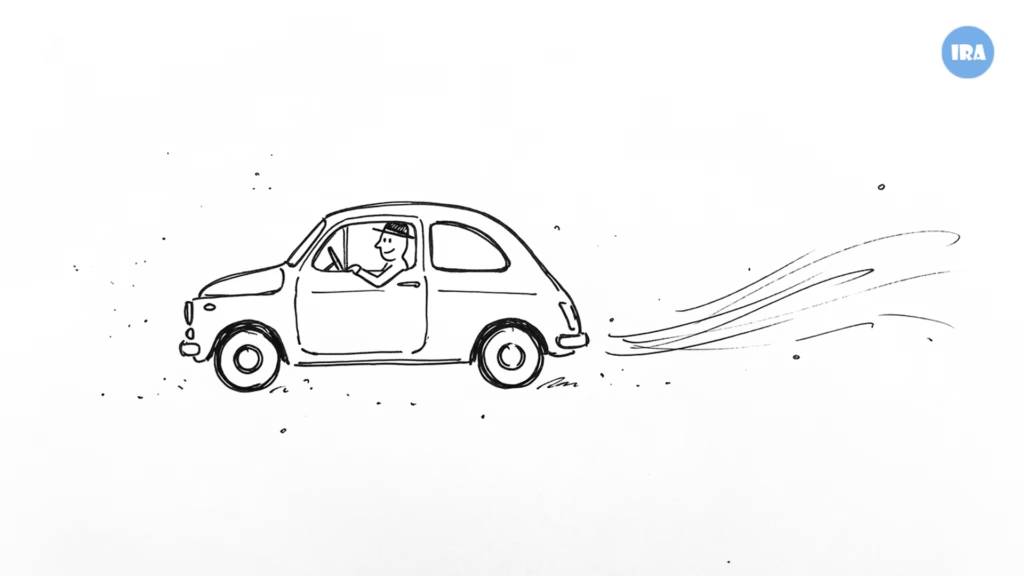
Our bodies are much better at detecting changes in motion than detecting constant speed.
Think about a car. When it accelerates away from a traffic light, you feel yourself pushed back into your seat. When the driver brakes suddenly, your body moves forward. When the car takes a sharp turn, you feel yourself lean to one side.
These sensations occur because your body’s motion is changing.
Earth’s rotation and orbit, however, are relatively smooth and predictable. We don’t experience the sudden changes in motion that we feel in a car or on a roller coaster.
Strictly speaking, Earth’s motion isn’t completely constant: rotation involves centripetal acceleration, and its orbit is curved. But these effects are small enough that we don’t notice them in everyday life.
3. Earth's Gravity Keeps Us on the Ground
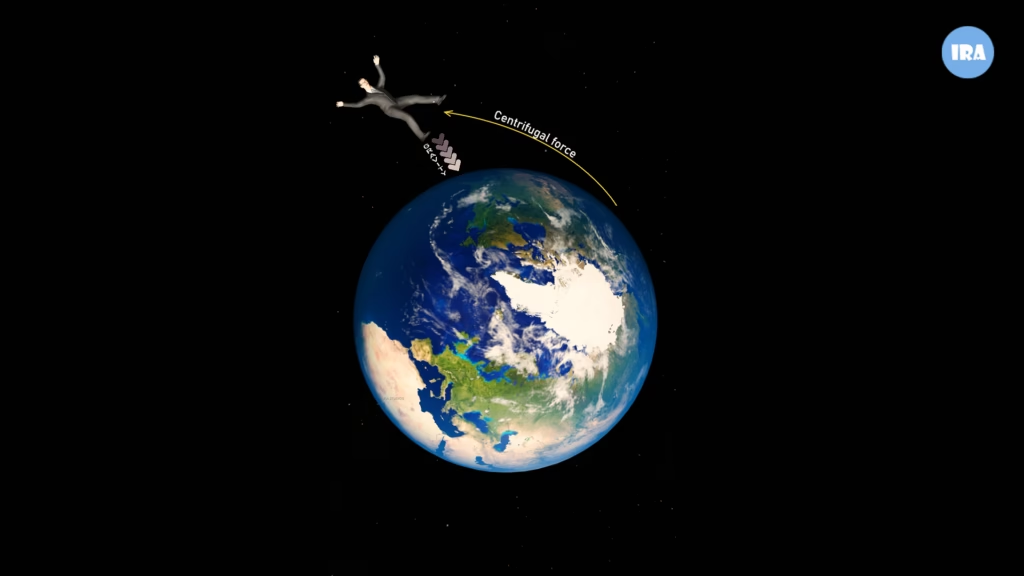
Earth’s gravity pulls us toward its center, keeping us and everything around us attached to the planet.
But if Earth is spinning so quickly, shouldn’t that rotation throw us off the surface?
Not at all.
Earth’s rotation does produce an outward effect in the rotating reference frame, commonly called the centrifugal effect. However, this effect is much weaker than gravity.
At the equator, the centrifugal acceleration is only about 0.034 m/s², compared with gravitational acceleration of about 9.8 m/s². In other words, the rotational effect is only around 0.35% of gravity.
That means gravity easily keeps us on the ground despite Earth’s rotation.
Can We Actually Detect Earth's Motion?
Yes! Even though we don’t feel Earth’s enormous speed directly, we can measure its motion and observe its effects.
For example:
Day and night: Earth’s rotation causes different parts of the planet to face toward or away from the Sun.
The Coriolis effect: Earth’s rotation influences the movement of large-scale air and ocean currents.
Foucault pendulums: These experiments demonstrate Earth’s rotation by showing how the apparent direction of a pendulum’s swing changes over time.
So, Earth isn’t motionless. We simply don’t experience its motion in the same way we experience sudden acceleration or a sharp turn.
Watch the Full 3D Animation
To explore all of these processes in 3D, check out our detailed 3D Animation video.
Watch it in Malayalam!
Want to learn more through visual storytelling? Check out our detailed 3D explanation blog on Why Do We Always See the Same Side of the Moon? Tidal Locking Explained with 3D visuals