Evolution explained!
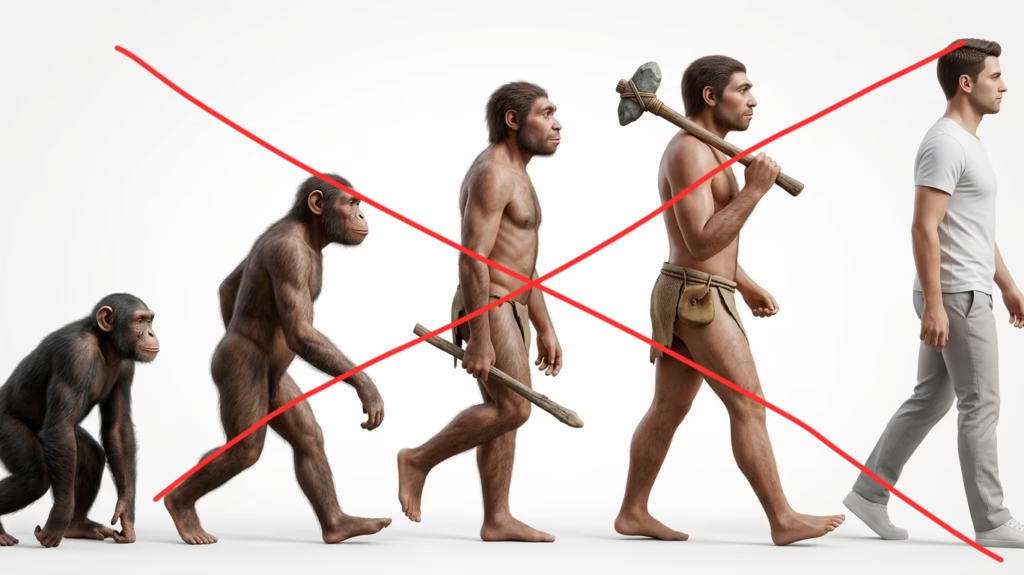
Many people misunderstand evolution because of a famous image showing a monkey gradually transforming into a human. This image is often used to represent human evolution, but it can give the wrong impression that humans evolved directly from the monkeys we see today.
The scientific explanation is different: humans and modern monkeys share common ancestors that lived millions of years ago. Our evolutionary lineages branched off and developed in different ways over time. Humans did not evolve from the monkeys or chimpanzees living today.
What Is Evolution?
Evolution is the process by which inherited characteristics of populations change over generations.
Every living organism carries genetic information in its DNA. This information influences many of its characteristics, from physical features to how its body functions.
According to the American Museum of Natural History, changes in DNA and the information it contains have played a central role in the evolution of life. Over billions of years, evolutionary changes have contributed to the extraordinary variety of organisms found on Earth today, from tiny microorganisms to humans.
But how do these changes begin?
Where Does Variation Come From?
Look at a group of people. Some have brown eyes, while others have blue or green eyes. People also differ in blood type, height and many other characteristics.
Similar differences exist among other living organisms. Scientists call these differences variation, and variation provides the raw material for evolutionary change.
Two important sources of genetic variation are mutations and recombination.
1. Mutations: Changes in DNA
A mutation is a change in DNA. Mutations can occur when genetic material is copied or through other biological processes.
Some mutations have little or no effect on an organism. Others can be harmful, while some can provide an advantage in a particular environment.
For example, a genetic mutation may help an organism resist a disease. In another environment, the same mutation might provide no advantage at all.
Mutations do not occur because an organism needs a particular feature. They arise without regard to whether the resulting change will be helpful.
2. Recombination: New Combinations of DNA
Offspring inherit genetic information from their parents, but they do not receive exactly the same combination of DNA as their siblings.
During the formation of sperm and eggs, chromosomes exchange and reshuffle genetic material. This process is called recombination.
As a result, each child inherits a unique combination of genetic information from their parents.
Mutations and recombination help create the differences that evolutionary processes can act upon.
What Is Natural Selection?
Not every inherited variation has the same effect on survival and reproduction.
Some traits can give an organism an advantage in a particular environment. When individuals with those inherited traits produce more offspring, the traits may become more common in future generations.
This process is called natural selection.
Let’s understand it with a simple example.
Imagine a population of butterflies living in a forest. Some have light-coloured wings, while others have dark-coloured wings.
At first, both types live in the same environment. Then the tree bark becomes darker.
Birds may find the lighter butterflies easier to spot, while the darker butterflies blend into the background. As a result, darker butterflies may survive and reproduce more successfully.
Their offspring may inherit the traits associated with darker colouring. Over many generations, dark-coloured butterflies could become more common in the population.
That is natural selection in action.
The butterflies do not change their colour because they decide to adapt. Instead, inherited variations already exist, and the environment influences which individuals leave more offspring.
Natural selection depends on the environment. A trait that provides an advantage in one place may be less useful in another.
Does Natural Selection Explain All Evolution?
No. Although natural selection is an important mechanism of evolution, it is not the only one.
Another process is called genetic drift.
Genetic drift happens when the frequency of genetic variations changes by chance over generations. Unlike natural selection, these changes do not necessarily happen because a particular trait gives an organism an advantage.
Imagine a small population of butterflies with two types of wing markings. If the markings do not affect survival, either type may become more common simply by chance.
For example, some butterflies may happen to produce more offspring than others, causing their genetic variants to become more frequent in later generations.
The American Museum of Natural History explains that genetic drift can contribute to differences between populations, especially when populations are small or relatively isolated.
Together, natural selection, genetic drift and other evolutionary processes help shape the genetic characteristics of populations over time.
Did Humans Evolve From Monkeys?
Now let’s return to the original question.
Humans did not evolve from modern monkeys or modern chimpanzees. Instead, humans and other primates share ancestors that lived in the distant past.
Think of evolution as a branching tree.
A tree begins with a trunk and develops many branches. Each branch can split into smaller branches, which continue growing in different directions.
Evolution works in a similar way. An ancestral population can give rise to different evolutionary lineages. Over millions of years, these lineages accumulate different inherited characteristics.
The lineage that eventually led to modern humans and the lineage that led to modern chimpanzees followed separate evolutionary paths after diverging from a shared ancestral population.
This means chimpanzees are not our ancestors in the simple sense that the monkeys living today are not our ancestors either. They are living relatives with their own evolutionary history.
How Did Humans Evolve?
Human evolution was not a sudden event in which a monkey gave birth to a human.
It involved populations changing over millions of years. Different human-related species existed at different times, and many eventually became extinct.
Scientists reconstruct this history by studying fossils, comparing DNA and examining similarities in the anatomy of humans and other primates.
These different forms of evidence help researchers understand how our ancestors changed and how humans are related to other living organisms.
It is also important to understand that evolution is not a ladder, with humans at the top. It is a branching process. No species is destined to become human, and evolution does not always make organisms more complex.
Every living species has its own evolutionary history.
Is Evolution Still Happening Today?
Yes. Evolution is still happening today. It is not something that stopped millions of years ago.
Evolution occurs when the inherited characteristics of populations change across generations. Scientists can observe this process in living organisms.
Consider antibiotic resistance in bacteria.
Within a bacterial population, some bacteria may carry genetic variations that help them survive a particular antibiotic. When the antibiotic kills susceptible bacteria, resistant bacteria may survive and reproduce. Over generations, resistance can become more common in the population.
A similar process can occur in insects exposed to pesticides. Insects with inherited resistance may survive and produce more offspring, allowing resistance to spread.
These examples demonstrate how genetic variation and natural selection can change populations over relatively short periods.
Evolution does not mean that an individual organism transforms into a different species during its lifetime. The change happens across generations as inherited characteristics become more or less common in a population.
How Do Scientists Know Evolution Happens?
Scientists support the theory of evolution through multiple lines of evidence.
Fossils: Fossils preserve evidence of organisms that lived in the past. They help scientists investigate how life forms have changed through geological time.
DNA: Comparing genetic information reveals similarities and differences between organisms. These patterns help scientists identify evolutionary relationships and investigate common ancestry.
Anatomy: Different organisms often share underlying structural features, even when those features perform different functions. These similarities can provide evidence of shared ancestry.
Evolution observed today: Changes in living populations, including antibiotic resistance in bacteria, provide direct evidence that inherited characteristics can evolve over generations.
No single example explains the entire history of life. Together, these lines of evidence provide a detailed picture of how organisms are related and how life has changed over time.
Want to learn more through visual storytelling? Check out our detailed 3D explanation blog on Why do we cough? 3D Visual Explanation